
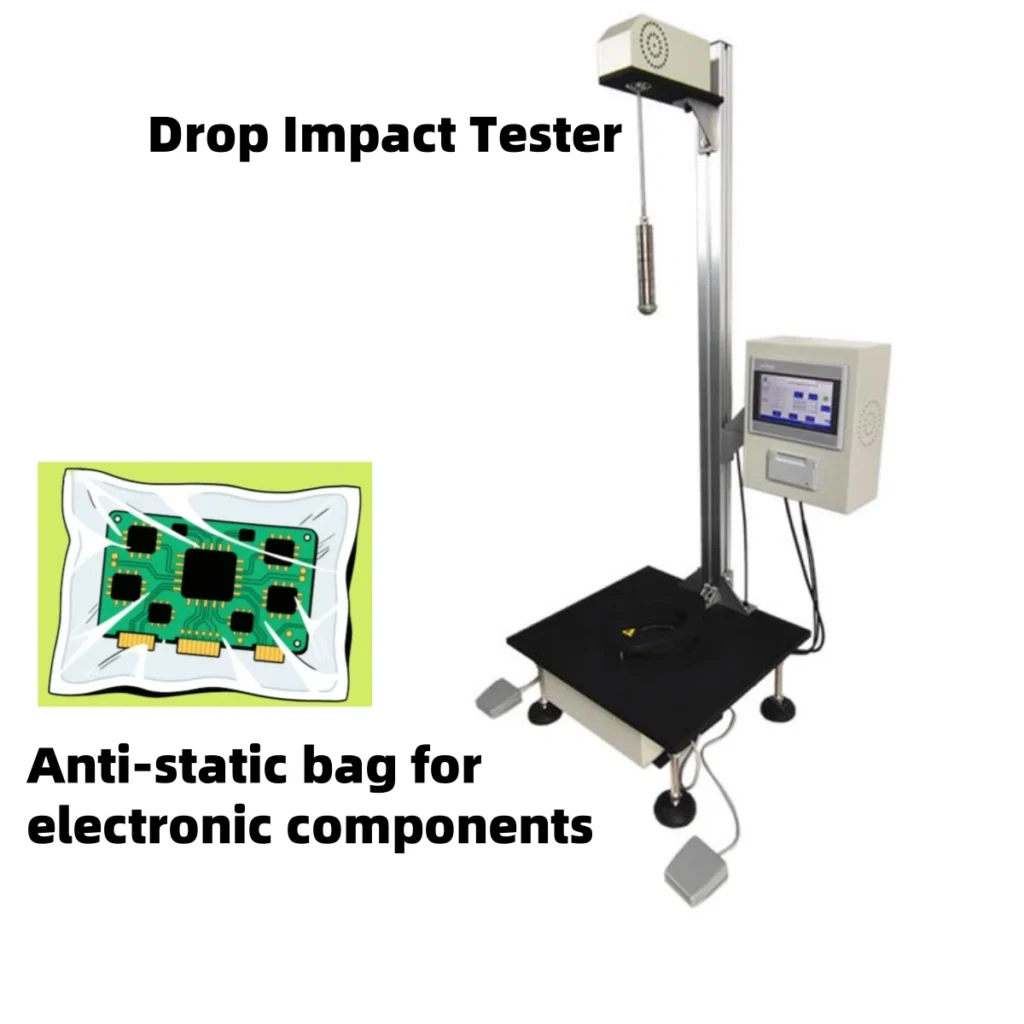
In materials testing, the drop impact tester plays a vital role in verifying the durability of plastic films used in protective packaging. This testing is especially crucial for anti-static bags for electronic components, where both static protection and mechanical strength are essential to prevent costly damage during handling and shipping. Following ASTM D1709 standards helps manufacturers ensure these bags meet rigorous impact resistance requirements.
Why Impact Resistance Testing is Essential for Anti-Static Bags for Electronic Components
Anti-static bags for electronic components serve as the first line of defense against static electricity and physical damage. Electronic components are highly sensitive; even minor impacts can lead to failures, compromising device functionality and reliability. The mechanical integrity of the bag’s plastic film is critical to withstand accidental drops, impacts, or pressure during transportation and storage.
Using a drop impact tester according to ASTM D1709, manufacturers can accurately measure the impact resistance of these films. This ensures that the anti-static bags will not tear or puncture under typical handling conditions, safeguarding sensitive electronics and reducing product failure rates.
Overview of ASTM D1709 Drop Impact Testing Methods
ASTM D1709 outlines two standard methods to measure film impact resistance:
Test Method A uses a hemispherical dart (38.1 mm diameter) dropped from 0.66 meters. This is suitable for films needing missile weights of about 50 g to 6 kg to cause failure.
Test Method B employs a larger dart (50.8 mm diameter) dropped from 1.52 meters, for weights ranging from 0.3 kg to 6 kg.
Both methods provide standardized, reproducible conditions to evaluate impact resistance, though their results are not directly interchangeable.
Conducting Accurate Tests for Anti-Static Bags
To obtain reliable and meaningful results when testing anti-static bags, follow ASTM D1709 protocols:
- Specimen Selection: Use samples representative of production, free of defects like pinholes or wrinkles.
- Conditioning: Maintain specimens at 23 ± 2°C and 50 ± 10% relative humidity for at least 40 hours prior to testing to stabilize film properties.
- Equipment Setup: Choose the appropriate dart size and set the drop height precisely. Ensure consistent dart impact at the center of the clamped specimen.
- Testing Technique:
- Staircase Method: Adjust dart weight incrementally based on specimen pass/fail results to determine the weight causing 50% failure.
- Alternative Method: Test groups of ten specimens at fixed weights, varying missile weights between groups to map failure percentages.
These procedures deliver accurate impact resistance data crucial for qualifying anti-static bags.
Special Considerations for Anti-Static Bags
Testing anti-static bags for electronic components presents unique challenges:
- The plastic films used must provide both static dissipation and mechanical protection, so impact resistance testing must be complemented by electrostatic discharge (ESD) testing.
- Anti-static films may behave differently under impact due to additives or special coatings, so manufacturers should test multiple samples from different production batches to ensure consistent quality.
- Packaging applications often require compliance with additional standards beyond ASTM D1709, so impact resistance results should be integrated into a broader quality control framework.
Why Choose Cell Instruments’ Drop Impact Tester for Anti-Static Bag Testing?
Cell Instruments’ falling dart impact tester offers precision and reliability, fully compliant with ASTM D1709. Our instrument features adjustable dart weights and heights, secure clamping to prevent specimen slippage, and a smooth dart release system. This ensures consistent, accurate testing results every time.
By using Cell Instruments’ drop impact tester, manufacturers and quality control professionals gain confidence that their anti-static bags for electronic components meet necessary impact resistance standards—protecting sensitive devices and minimizing returns or failures.
Заключение
Testing the impact resistance of anti-static bags for electronic components with a drop impact tester according to ASTM D1709 is critical for ensuring packaging durability and device safety. This testing protects delicate electronics from damage during transport and handling, safeguarding product quality and brand reputation.
Trust Cell Instruments for precise, standardized drop impact testing solutions that uphold the highest quality standards for your packaging films.
 RU
RU  EN
EN  AR
AR  BG
BG  CS
CS  DA
DA  DE
DE  EL
EL  ES
ES  ET
ET  FI
FI  FR
FR  HU
HU  ID
ID  IT
IT  JA
JA  KO
KO  LT
LT  LV
LV  NB
NB  NL
NL  PL
PL  PT
PT  RO
RO  SK
SK  SL
SL  SV
SV  TR
TR  UK
UK