
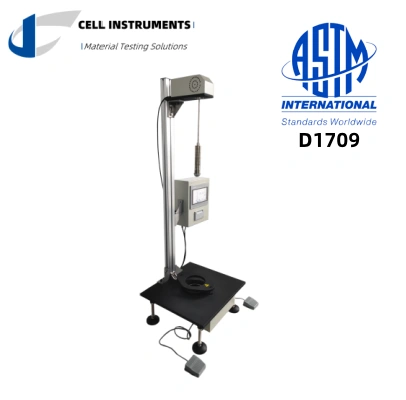
Den free falling dart test plays a critical role in evaluating the impact resistance of plastic films and flexible packaging materials. In industries where packaging integrity directly affects product safety, shelf life, and transportation reliability, understanding how materials respond to sudden impact loads becomes essential. Based on the internationally recognized ASTM D1709 standard, the free falling dart test provides a practical and repeatable way to quantify a film’s resistance to puncture and rupture caused by falling objects.
Impact Resistance and ASTM D1709 Fundamentals
Impact resistance describes a plastic film’s ability to withstand sudden mechanical forces without failure. ASTM D1709 defines the free falling dart test as a controlled impact test where a hemispherical dart falls from a fixed height onto a clamped film specimen.
The standard establishes two complementary test methods:
- Method A uses a 38.1 mm hemispherical dart dropped from 0.66 m
- Method B uses a 50.8 mm hemispherical dart dropped from 1.52 m
Both methods determine the dart mass that causes 50% specimen failure, a statistically meaningful indicator of material performance. A calibrated drop dart impact tester ensures consistent dart geometry, drop height, and specimen clamping, which are essential for reproducible results.
By focusing on controlled energy input rather than subjective judgment, ASTM D1709 enables laboratories to compare materials manufactured under similar conditions with confidence.
Purpose of the Free Falling Dart Test in Packaging Quality Control
The primary purpose of the free falling dart test is to assess how plastic films behave under real-world impact scenarios. During packaging, handling, and transportation, films may encounter sudden impacts from sharp or blunt objects. The test simulates these conditions in a laboratory environment.
Key objectives include:
- Determining the impact resistance threshold of films
- Supporting material selection for flexible packaging
- Monitoring production consistency and film uniformity
- Establishing acceptance criteria for quality inspection
ASTM D1709 recognizes that impact performance depends on multiple factors, including film fabrication method, thickness uniformity, and surface quality. As a result, the standard emphasizes consistent specimen preparation and controlled test conditions.
Free Falling Dart Test Process and Key Testing Techniques
Den free falling dart test follows a structured procedure designed to balance accuracy and efficiency.
Specimen Preparation and Clamping
Film specimens are cut to the required size and clamped securely in the tester to create a uniform impact area. Proper clamping minimizes edge effects and ensures valid results.
Dart Selection and Drop Conditions
Depending on the chosen test method, the appropriate dart diameter and drop height are selected. The dart falls freely under gravity, delivering a defined impact energy to the specimen.
Staircase and Alternative Testing Techniques
ASTM D1709 outlines two equivalent approaches:
- Staircase method: Dart mass increases or decreases stepwise based on each test outcome
- Group method: Specimens are tested in sets using the same dart mass, adjusting between groups
Both techniques lead to the determination of the dart mass at which 50% failure occurs, ensuring statistically robust evaluation.
Why Reliable Equipment Matters for ASTM D1709 Testing
Accurate execution of the free falling dart test depends heavily on equipment performance. A high-quality drop dart impact tester ensures stable drop height, precise mass adjustment, and repeatable clamping conditions.
Den Cell Instruments FDT-01 falling dart impact tester supports both ASTM D1709 Test Methods A and B, offering controlled test execution for laboratories and production facilities. Its design emphasizes operational consistency, helping users obtain dependable impact resistance data for specification development and quality control.
Conclusion: Practical Value of the Free Falling Dart Test
Den free falling dart test remains one of the most widely adopted methods for evaluating plastic film impact resistance. By following ASTM D1709, manufacturers and quality professionals gain actionable insights into material durability under sudden mechanical stress.
With proper testing procedures and reliable instruments such as the Cell Instruments FDT-01, organizations can improve packaging performance, reduce material failure risks, and strengthen confidence in flexible packaging solutions across demanding applications.
 NB
NB  EN
EN  AR
AR  BG
BG  CS
CS  DA
DA  DE
DE  EL
EL  ES
ES  ET
ET  FI
FI  FR
FR  HU
HU  ID
ID  IT
IT  JA
JA  KO
KO  LT
LT  LV
LV  NL
NL  PL
PL  PT
PT  RO
RO  RU
RU  SK
SK  SL
SL  SV
SV  TR
TR  UK
UK